Six maps
Raphael, The School of Athens, 1509–1511. Plato and Aristotle argue at its centre.
What you get
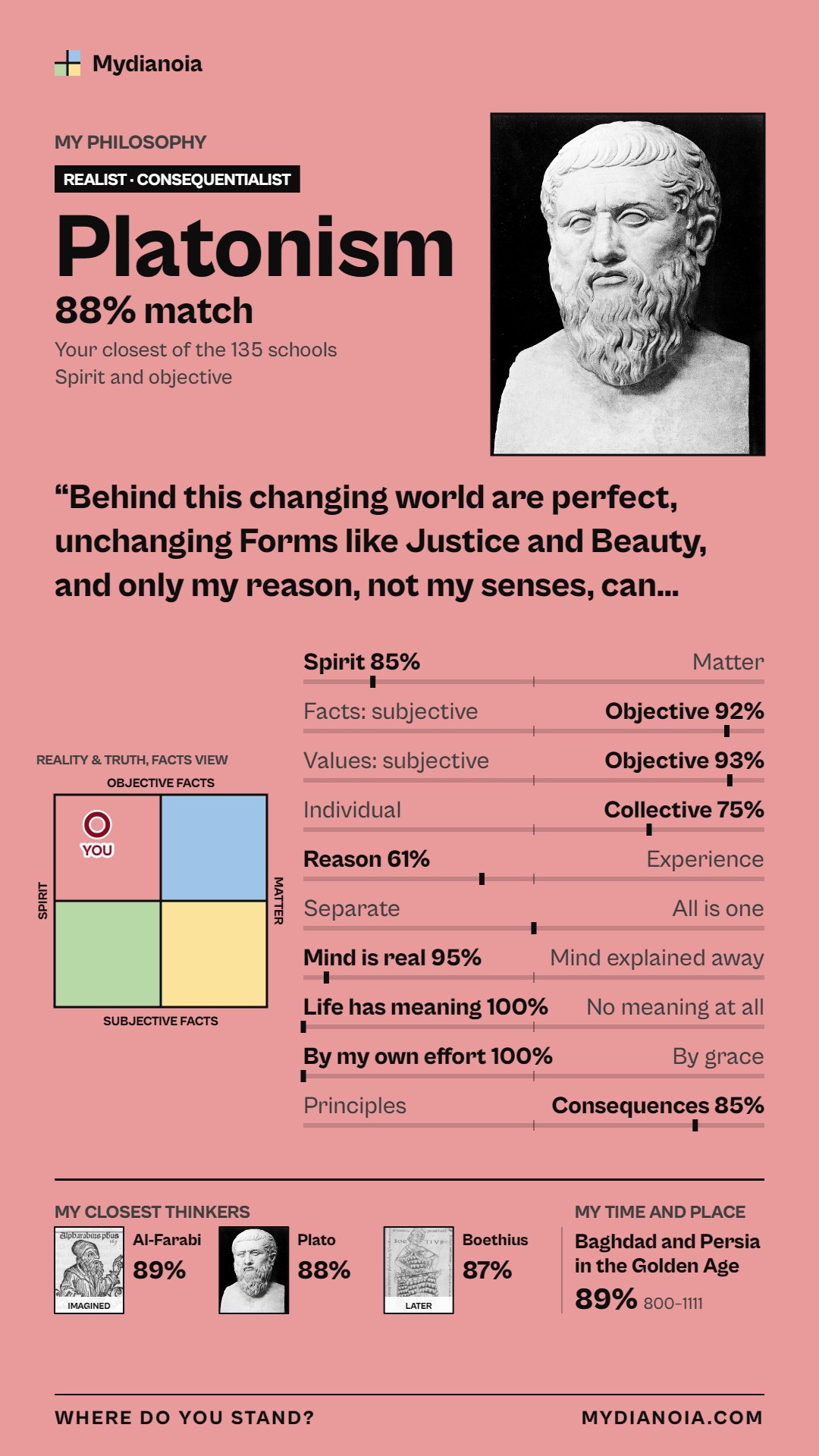
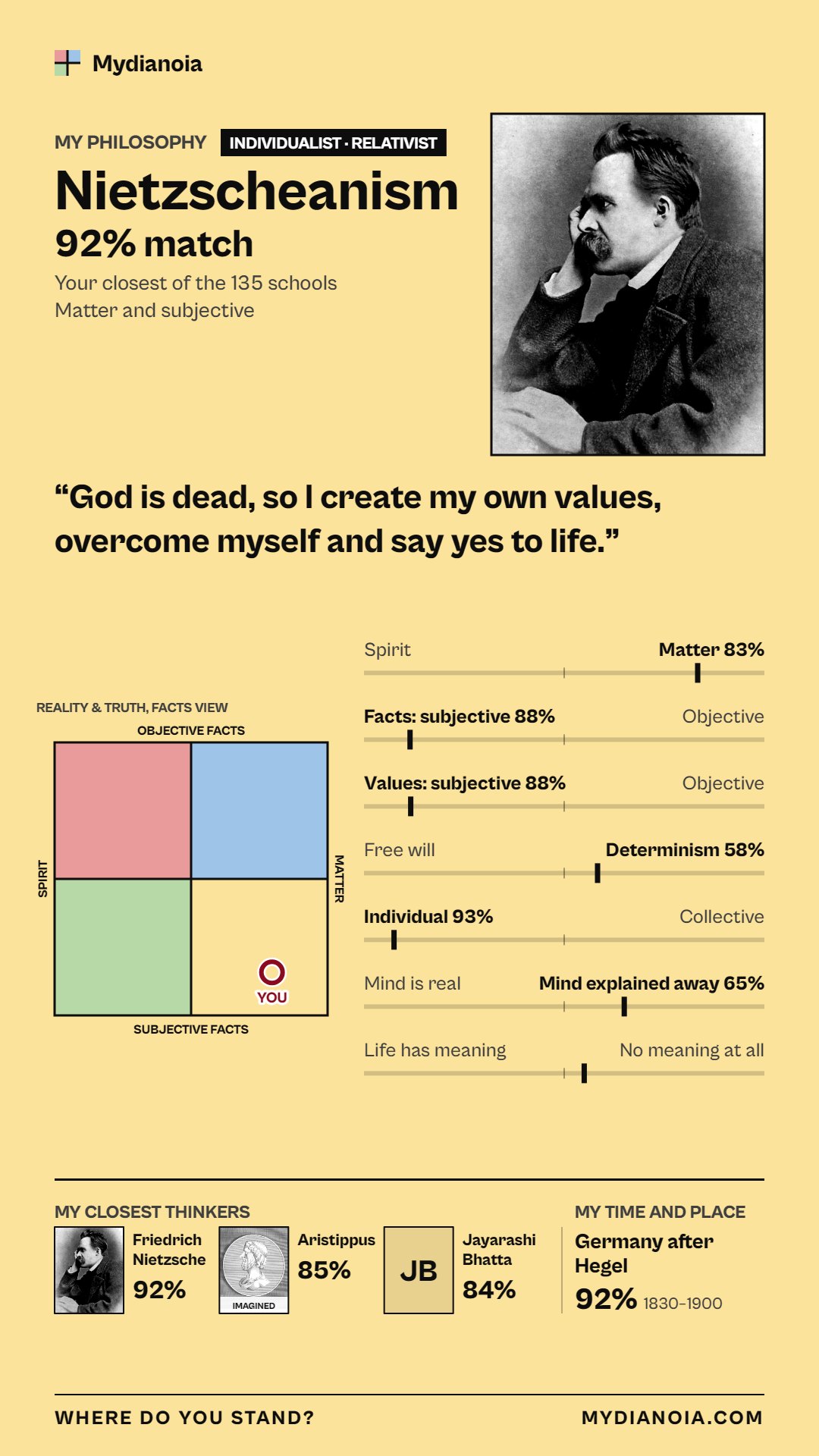
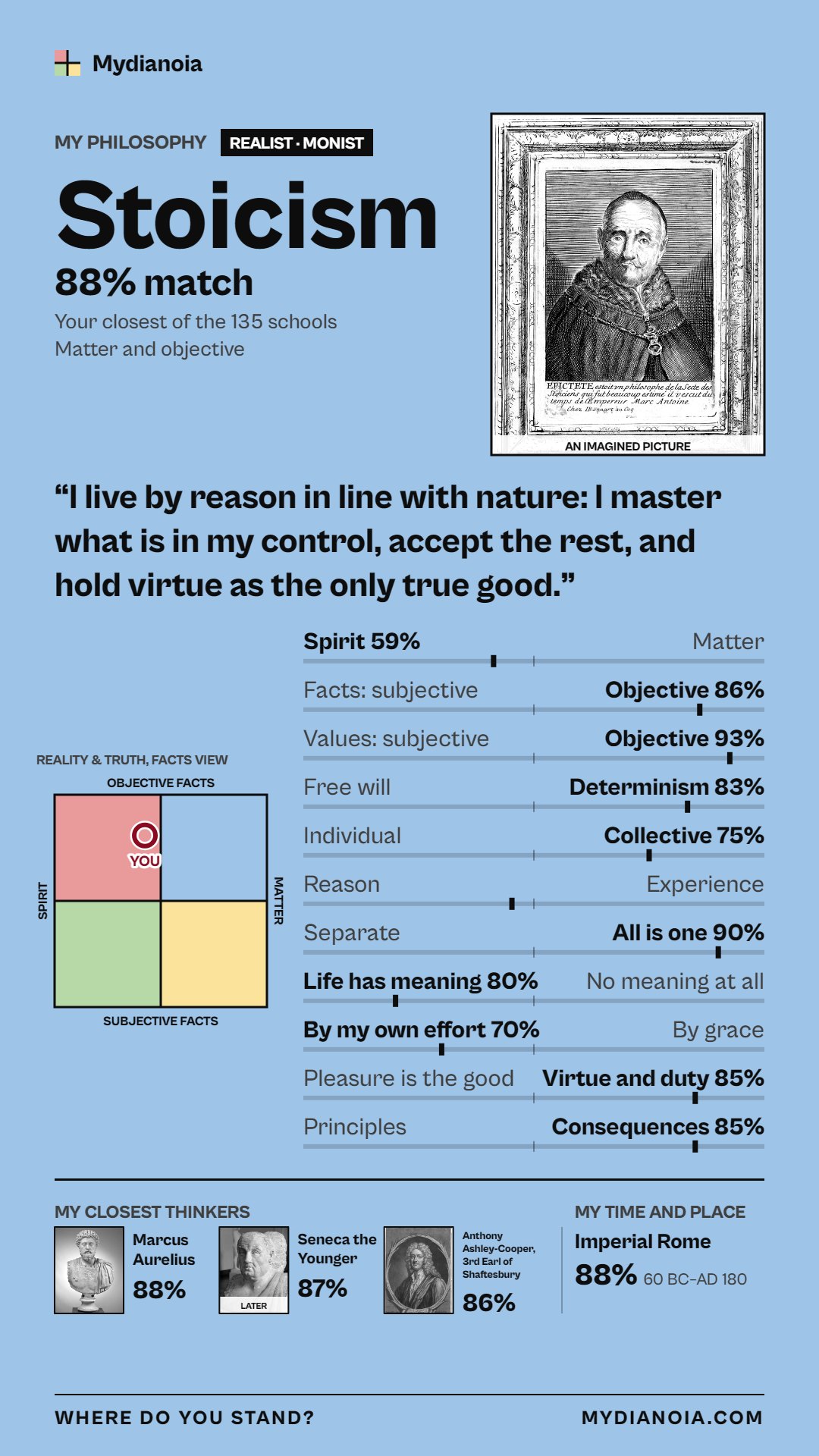
- Your school, with a % match. The closest of the 135 schools on the map, and how close.
- Two answers, not one. Where you stand on what is real (the map’s facts view) and on what is right (its values view). They can land far apart.
- Fifteen more scales. Free will or determinism, the individual or the group, reason or experience, whether God exists, whether life has meaning, and ten more. Five more maps put them side by side, two at a time.
- Your thinkers. All 744, ranked from closest to furthest, overall and by field, each with a key book.
- A link to share. Send it to a friend and see where the two of you part ways.
Famous results
Three famous minds take the Full quiz, each picking the answer nearest to what their own works say. These are the cards they get.
How it works
Quick, full or deep: 11, 21 or 48 situations.
- 1
Answer a situation
A teleporter, a ring that makes you invisible, a machine that gives you any life you want. Pick what you would really say. Unsure what it is asking? Press “Understand this question” first.
- 2
One at a time
Back, Next, and Swap for a situation that doesn’t speak to you.
- 3
See where you stand
At the end: your school, your thinkers and your 18 scales, ready to share. Change an answer later and your result changes with it.
Before you start
Straight answers about the quiz.
Is it free?
Yes. There is no sign-up, no email and nothing to pay.
Do you keep my answers?
Your answers are saved only in this browser, on this device. They are never sent to a server. The address of your result page holds them too, so a bookmark brings your result back; like a share link, it leaves your device only if you send it. Clearing your browser data deletes the saved copy.
Do I need to know any philosophy?
No. Every situation is an everyday story. If you are not sure what a question is getting at, press “Understand this question” before you answer: it explains what each answer would mean, without telling you which school it leads to.
How many questions are there?
You choose: a quick version with 11 situations, the full one with 21, or a deep one with 48. There is no clock. Each situation is a short story with 3 to 13 answers.
Is it scientific?
No. It is a tool for thinking, not a test anyone has validated. Where we place the 135 schools and 744 thinkers are our estimates from their main works and public statements, and people argue about where many of them belong.
Why does the map have two views?
The facts view places your ring by what you think is real and how we know it. The values view places it by what you think is right and how to live. The two can land in different places: you might think only matter exists and still think right and wrong are fixed.
What does the % match mean?
How close two positions are on the scales they share. 100% means the same spot on every scale, 0% means opposite ends of all of them. Where we have no estimate for someone on one of your scales, it counts a little as an average gap, so a person we know on only a few scales can’t top your list by luck. A school’s % leaves out God or no God: belief in God splits more schools than any other scale, so that scale places you among thinkers, circles and rivalry sides but never chooses your school. The doubt scale (we can know, or suspend judgment) is left out of a school’s % the same way, as counting it moved more people away from their own school than it helped. If you name the tradition whose teaching you trust most, its schools get 5 points more and other traditions’ schools 5 less.
What are the fifteen bars?
Fifteen more scales the Reality & truth map does not show: free will or determinism, the individual or the group, reason or experience as the way to know, whether whatever is highest (God, the One, Nature) is apart from you or one with you, whether your inner life is real or explained away by the brain, whether life has a meaning, whether you can be sure other people have minds, and whether the way to the highest truth is your own effort or grace, whether pleasure or virtue and duty makes a life good, whether principles or consequences make an act right, whether God exists, whether technology should be sped up or held back, whether qualities like redness exist beyond things, whether to think by logic or by lived experience, and whether we can know anything or must suspend judgment. On your result page, five more maps beside Reality & truth put these scales side by side, two at a time: four ready-made pairs, and one where you pick any two.
What if my result doesn’t match the label I use for myself?
That happens. A label names a whole tradition, while the quiz looks at single views. You can share some views with a school and not others, and your result shows which.
Can I change an answer or start over?
Yes. Go back to any situation and pick another option, and your result changes with it, or press “Start over” to clear everything.
Can I compare with a friend?
Yes. Copy your result link and send it. When your friend sends theirs back, paste it on the Compare page to see where the two of you part ways, scale by scale.