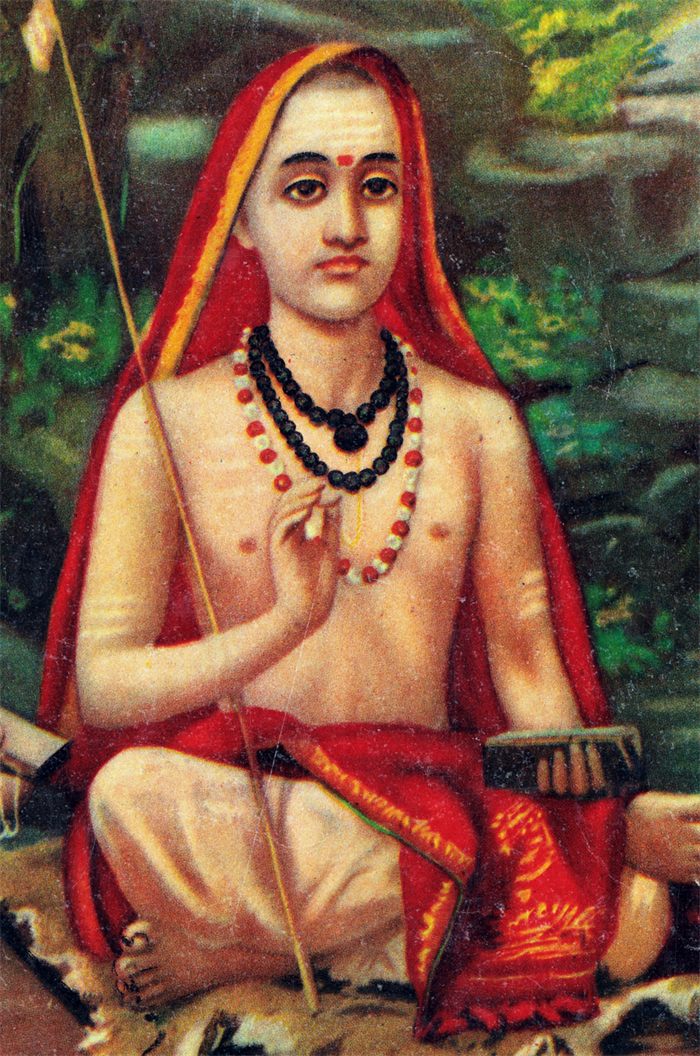
In one sentence
My deepest self and ultimate reality, Brahman, are one; feeling separate from everything else is an illusion.
How someone from Advaita Vedanta might sum up what they believe. Our summary, not a quotation.
Key thinkers
 Adi Shankara8th century · Commentary on the Brahma Sutras
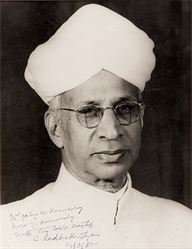 Sarvepalli Radhakrishnan1888–1975 · An Idealist View of Life
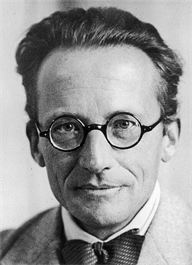 Erwin Schrödinger1887–1961 · What Is Life?
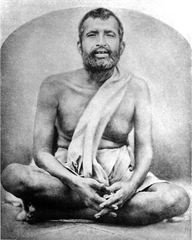 Ramakrishna1836–1886 · Sri Sri Ramakrishna Kathamrita (by Mahendranath Gupta)
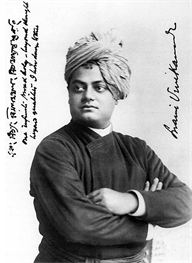 Swami Vivekananda1863–1902 · Raja Yoga
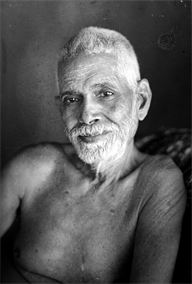 Ramana Maharshi1879–1950 · Nan Yar? (Who Am I?)
Where it leans
A whole worldview, about both. Positions are our estimates; philosophers argue about where many schools belong.
Most unusual position
96%On spirit or matter, it leans further toward spirit than 96% of the 135 schools on the map.
Middle of all schools on the map: 39 · This school: 6 (0 = Spirit, 100 = Matter)
Most typical position
Subjective or objectiveOn subjective or objective, it sits close to the middle of the schools on the map.
Middle of all schools on the map: 79 · This school: 79 (0 = Subjective, 100 = Objective)
Where it comes from
What came before Advaita Vedanta and led into it, and what grew out of it. Only links that historians agree on.
Came before it
- The Upanishads (from around 800 BC)
- The Bhagavad Gita (around 2nd century BC)
- Gaudapada (around 6th century)
- Adi Shankara (8th century), its classic teacher
Grew out of it
- Vidyaranya (14th century)
- Swami Vivekananda (19th century)
- Ramana Maharshi (20th century)
- Sarvepalli Radhakrishnan (20th century)
One thing to practise
A real practice from Advaita Vedanta, to try this week. Described in our words.
Self-enquiry: who am I?
Sit quietly. Whenever a thought arises, ask: to whom does this thought come? The answer is: to me. Then ask: who am I? and turn your attention back to the sense of I itself, instead of following the thought.
From: Ramana Maharshi, Who Am I? (Nan Yar?, answers first given around 1902)
Its strongest argument
The best case Advaita Vedanta makes against people who see the world very differently, in two sentences. People whose furthest school this is see it on their result.
Everything you observe changes, your body, your thoughts and your moods, yet something in you is aware of all of them and never shows up as one more object. So if you take yourself to be the body or the stream of thoughts, Advaita asks who it is that watches both.
The argument in our own words, not a quotation.
Where it sits
On the maps
Each map puts two scales side by side. Each small square is a school, at its exact spot; its name shows where there is room. For the others, point at the square, or tap it once on a phone. The first, Reality & truth, puts spirit or matter across and subjective or objective up and down. Click a school, or tap it again, to open it.
Swipe sideways to see the whole chart.
Thinkers in this school
Pictured thinkers nearest this spot on the map
Neighbours on the map
The six schools closest to this one.
- SufismIslamic mysticism: the heart can come to know God directly through love, remembrance and the dissolving of the self.
- KabbalahJewish mysticism that reads hidden meanings in scripture and maps how the infinite God shows itself through creation.
- MysticismThe deepest truth is reached by direct inner experience of the divine or the One, beyond words and reasoning.
- Berkeleyan IdealismOnly minds and their ideas exist; to be is to be perceived, and God keeps the world in being by perceiving it.
- IdealismReality is basically mental; the material world depends on minds.
- HasidismJewish mystical revival that teaches God is present in everything, so even simple acts done with joy can bind you to God.
And you, where do you stand?
Take the quiz and see your match with Advaita Vedanta and the other 134 schools.
Take the quiz