In one sentence
I look for the one natural stuff behind everything and argue it out in the open, without calling on the gods.
How someone from Milesian school might sum up what they believe. Our summary, not a quotation.
Key thinkers
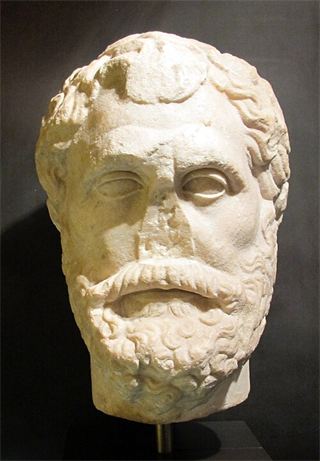
 Thales of Miletusc. 626–545 BC · Metaphysics (by Aristotle)
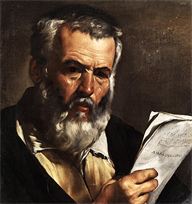 Anaximanderc. 610–546 BC · On Nature
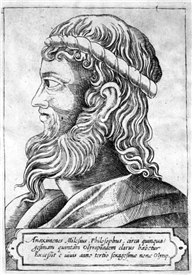 Anaximenes of Miletusc. 586–526 BC · Fragments (DK 13)
Where it leans
About what is real and how we know. Positions are our estimates; philosophers argue about where many schools belong.
Most unusual position
71%On spirit or matter, it leans further toward matter than 71% of the 135 schools on the map.
Middle of all schools on the map: 39 · This school: 75 (0 = Spirit, 100 = Matter)
Most typical position
FactsOn facts (subjective or objective), it sits close to the middle of the schools on the map.
Middle of all schools on the map: 79 · This school: 85 (0 = subjective, 100 = objective)
Where it comes from
What came before Milesian school and led into it, and what grew out of it. Only links that historians agree on.
Came before it
- c. 750-650 BC: Hesiod's Theogony and the myths of origins
- From 747 BC: Babylonian star records (from Nabonassar), and Egyptian geometry
Grew out of it
- Late 6th century BC: Pythagoras, who referred to Anaximander and Anaximenes
- c. 535-475 BC: Heraclitus develops Anaximenes' theory of change; Parmenides attacks it
- c. 510-428 BC: Anaxagoras adopts Anaximenes' account of how materials arise
One thing to practise
A real practice from Milesian school, to try this week. Described in our words.
Critical discussion (ask for the natural cause, then argue)
Pick something that happens in nature and ask what natural stuff and process causes it, with no gods in the answer. Say your theory out loud to someone, let them attack it, and attack theirs back. You do not have to agree with your teacher; the aim is a better theory, not loyalty.
From: Thales, Anaximander and Anaximenes, Miletus, 6th century BC
Its strongest argument
The best case Milesian school makes against people who see the world very differently, in two sentences. People whose furthest school this is see it on their result.
When earthquakes and storms are explained by angry gods, nobody can check the story or improve it. Explain them instead by natural stuff and natural processes, like the earth resting on water, and others can find the flaw and offer a better theory. A theory that can be shown wrong can be improved, which is how real knowledge grows; so even a believer gains by first asking what natural cause is at work.
The argument in our own words, not a quotation.
Where it sits
On the maps
Each map puts two scales side by side. Each small square is a school, at its exact spot; its name shows where there is room. For the others, point at the square, or tap it once on a phone. The first, Reality & truth, puts spirit or matter across and subjective or objective up and down. Click a school, or tap it again, to open it.
Swipe sideways to see the whole chart.
Thinkers in this school
Pictured thinkers nearest this spot on the map
Neighbours on the map
The six schools closest to this one.
- PsychoanalysisHidden wishes and conflicts in the unconscious mind drive what we feel and do, and talking freely can bring them to light so we can face them.
- Scientific RealismOur best scientific theories are roughly true, and the unseen things they describe, like electrons, really exist.
- Critical RationalismKarl Popper's view that knowledge grows by bold guesses and attempts to prove them wrong, never by proof.
- Emotivism"Stealing is wrong" is not a fact but an expression of feeling, roughly "boo, stealing!"
- Moral RelativismRight and wrong depend on the culture or person judging; there is no single moral truth for everyone.
- Evolutionary EthicsOur moral feelings were shaped by evolution because they helped our ancestors survive together.
And you, where do you stand?
Take the quiz and see your match with Milesian school and the other 134 schools.
Take the quiz