In one sentence
I keep silent, live simply and study number, because my soul is immortal and the world is built on harmony.
How someone from Pythagoreanism might sum up what they believe. Our summary, not a quotation.
Key thinkers
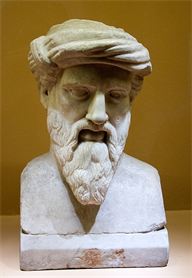 Pythagorasc. 570–495 BC · Lives and Opinions of Eminent Philosophers (by Diogenes Laërtius)
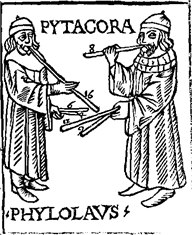 Philolausc. 470–385 BC · On Nature
 Archytasc. 420–350 BC · On Sciences (fragment B3)
Where it leans
A whole worldview, about both. Positions are our estimates; philosophers argue about where many schools belong.
Most unusual position
70%On spirit or matter, it leans further toward spirit than 70% of the 135 schools on the map.
Middle of all schools on the map: 39 · This school: 20 (0 = Spirit, 100 = Matter)
Most typical position
Subjective or objectiveOn subjective or objective, it is nearest to the other schools on the map, though still not in the middle.
Middle of all schools on the map: 79 · This school: 95 (0 = Subjective, 100 = Objective)
Where it comes from
What came before Pythagoreanism and led into it, and what grew out of it. Only links that historians agree on.
Came before it
- c. 750-650 BC: Homer's picture of the soul as a shade, which Pythagoras broke with
- 6th century BC: the Milesian philosophers (Anaximander, Anaximenes), whom Pythagoras referred to
Grew out of it
- c. 470-385 BC: Philolaus's book, used by Plato in the Phaedo and Philebus
- 1st century BC onward: Neopythagoreanism, absorbed into Neoplatonism by the 4th century AD (Iamblichus)
- 1619: Kepler's Harmony of the World (Copernicus also named Pythagoreans as forerunners)
One thing to practise
A real practice from Pythagoreanism, to try this week. Described in our words.
Pythagorean silence
Spend long stretches saying nothing, even when you have something to say. Treat it as training in self-control: listen, think, and speak only when it is worth it. New members of the school kept this silence for years before they were taught.
From: Pythagoras' community at Croton, 6th century BC; still admired in the 4th century BC (Isocrates)
Its strongest argument
The best case Pythagoreanism makes against people who see the world very differently, in two sentences. People whose furthest school this is see it on their result.
Pluck a string and halve it, and you hear the octave: the sounds we love follow exact ratios of whole numbers. If music is number, the whole world probably is too, so you only really understand a thing when you find the numbers in it. And if the soul outlives the body, then how you live now, with discipline, silence and fairness, matters far beyond this life; even someone who doubts the soul can test the first half on a string.
The argument in our own words, not a quotation.
Where it sits
On the maps
Each map puts two scales side by side. Each small square is a school, at its exact spot; its name shows where there is room. For the others, point at the square, or tap it once on a phone. The first, Reality & truth, puts spirit or matter across and subjective or objective up and down. Click a school, or tap it again, to open it.
Swipe sideways to see the whole chart.
Thinkers in this school
Pictured thinkers nearest this spot on the map
Neighbours on the map
The six schools closest to this one.
- RationalismReason alone, without the senses, can give us certain knowledge of how things are.
- ThomismThomas Aquinas' joining of Aristotle and Christianity: reason and faith agree, and morality follows from human nature as God made it.
- HegelianismReality is spirit coming to know itself through history, as each idea meets its opposite and both are lifted into something higher.
- AvicennismAvicenna's philosophy: God is the one Necessary Being from whom everything flows, and the soul exists apart from the body.
- Neo-ConfucianismA later Confucianism that added a metaphysics: a single principle runs through all things, and self-cultivation lets you see it.
- Transcendent PhilosophyMulla Sadra's school: existence itself is the one reality, in degrees; all things keep moving toward God, and philosophy joins reasoning, mystical insight and scripture.
And you, where do you stand?
Take the quiz and see your match with Pythagoreanism and the other 134 schools.
Take the quiz